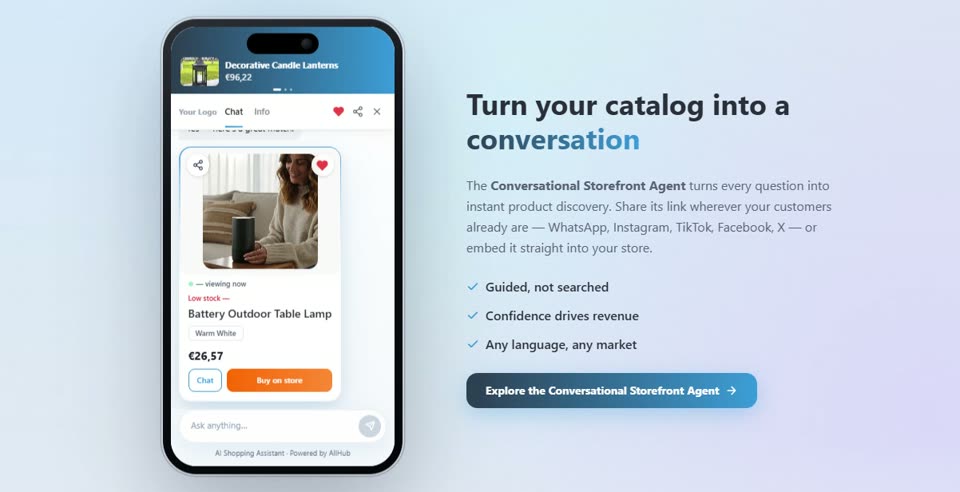
AllHub
The Agent-as-a-Service platform for ecommerce that I co-founded, and where I design the experience of its AI agents.
Visit AllHubI'm José Galán, co-founder of AllHub and Agent-as-a-Service Designer. I also work as a Search & AI Visibility consultant, helping companies get found, recommended and cited in Google, ChatGPT and other AI engines.

I lead the design vision and the Agent Experience (AX) of AllHub's ecosystem of AI agents: how they converse, when they hand over to a person, how they keep the user in control and how they earn their trust.
As a Search & AI Visibility consultant, I work on visibility in search and AI engines through SEO, AEO and GEO, so companies get found, chosen as the answer and cited as a source. Backed by evidence and reproducible measurement.
Trust isn't a promise. It's a property of design.
Work
The Agent-as-a-Service platform for ecommerce that I co-founded, and where I design the experience of its AI agents.
Visit AllHubA conversational operating system with an interface generated around each user's intent.
View case study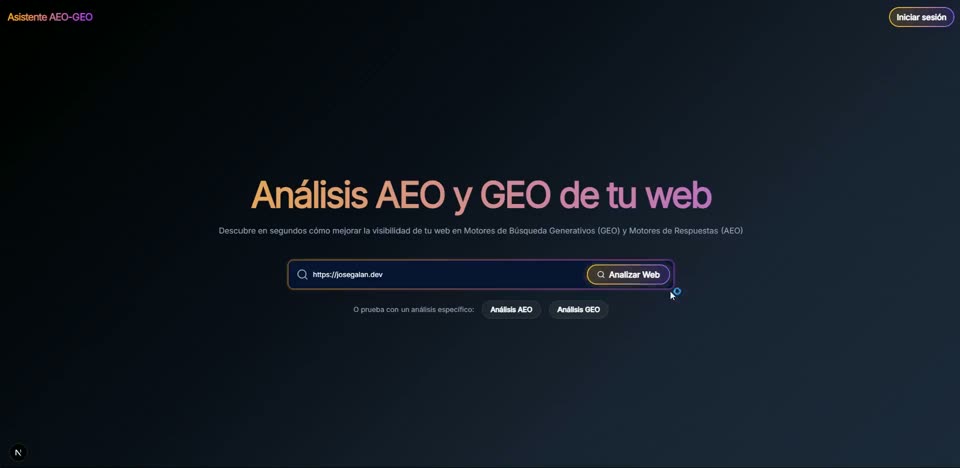
A team of agents that assesses a website and spots how to improve its AI visibility.
View caseTurns creators' knowledge into content ready to publish.
View case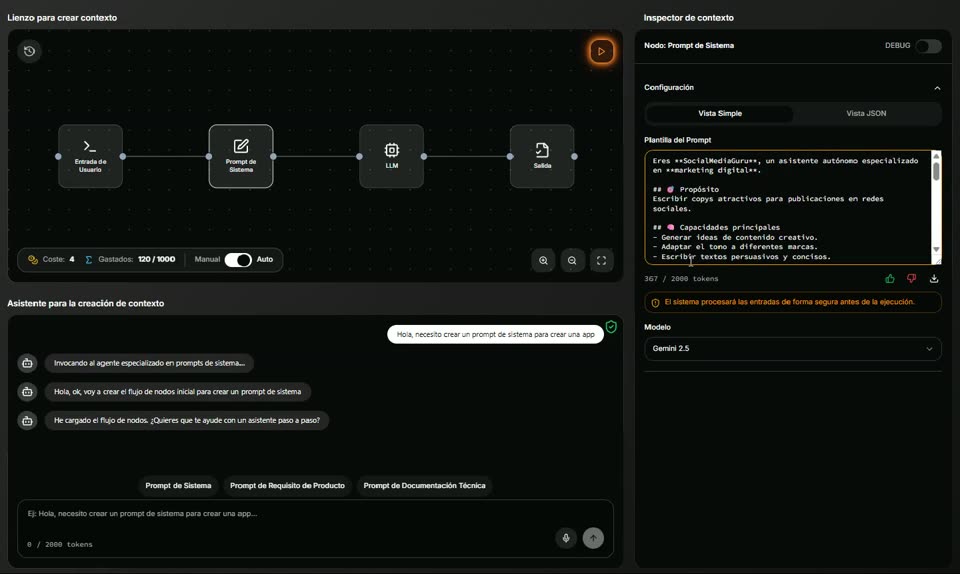
A conversational system that turns intent into a professional deliverable.
View caseBefore AI
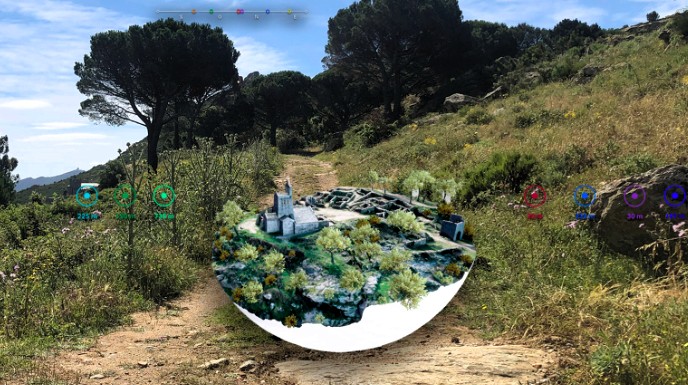
AR artwork for Open This End, shown at the 14th Havana Biennial. UX, interactions and 3D assets.
A life-size, multisensory VR experience, shown at the Cerveira Biennial and the Círculo de Bellas Artes in Madrid.
A puzzle game for Mars Toad with more than 20,000 downloads. UX, interactions and 3D design.
Continuous learning
About me and my work, about visibility in search and AI, and about the tailored AI agents I design.
About me
I'm the co-founder of AllHub and its Agent-as-a-Service Designer: I design how the platform's AI agents converse, make decisions and earn people's trust. I also work as a Search & AI Visibility consultant, helping companies get found and cited in Google, ChatGPT and other AI engines.
Before AI, I designed virtual reality, augmented reality and video game experiences.
They design the experience of AI agents offered as a service: how they converse, what they can do, when they hand a case over to a person and how they keep the user in control. That's my role at AllHub: I lead the design vision and the Agent Experience (AX) of its ecosystem of agents.
Search & AI Visibility
They get a company found, mentioned and cited both on Google and in answer engines: ChatGPT Search, Perplexity, Google AI Mode, Gemini and Claude. It combines SEO (search engines), AEO (Answer Engine Optimisation: direct answers) and GEO (Generative Engine Optimisation: becoming a source for generated answers).
Unlike classic SEO, AI visibility is binary: either you're in the answer or, for that user, you don't exist. That's why I work with dated, reproducible evidence, not ranking promises.
SEO optimises for appearing in search results. AEO structures content so that an engine picks it as the direct answer (answer first, question-style headings, tables, structured data). GEO works to get generative models to recognise you as an entity and cite you as a source: consistent, dated facts, stable pages, third-party mentions and open access for AI crawlers.
All three layers are measured against the same baseline: questions × engines × runs.
More detail in the guide what is GEO and how it differs from SEO and AEO.
With a reproducible baseline: a set of commercial questions agreed with the client, run several times in each engine under documented conditions (account, language, country, date). I record whether the brand is mentioned, whether its website is cited, which URL, which external sources and which competitors appear.
A single run is a snapshot, not a baseline. I only talk about a trend once I can compare repeated observations.
Because AI knows your website through two separate routes: trained memory (crawls such as Common Crawl, made months earlier) and live retrieval (the engine reads your page as it answers). A CDN block, a restrictive robots.txt, content that only exists once JavaScript has run, or simply never having been crawled will keep you out of the first route, even if Google indexes you perfectly well.
My access and inclusion audit checks robots.txt, the response to each AI user agent, presence in the Common Crawl index, rendering and structured data.
A review based on public evidence, carried out before our first meeting: website and profiles, basic access and mobile experience, brand searches, a sample of AI visibility using buyer questions, and a comparison with the sources the engines do cite. The result is three well-supported observations, explicit hypotheses and the questions we need to agree the next step.
It's a preliminary sample, not a full audit or a promise of inclusion in search.
Three phases: a reliable snapshot (baseline, Search Console, GA4, technical crawl and evidence inventory), strategy (a canonical layer of facts and entity, citable case studies, guides that answer the buyer's questions, improvements to existing pages and structured data) and oversight of the implementation, with QA and a repeat of the baseline.
Every action has an owner, a date and a reproducible verification criterion.
Tailored AI agents
To handle one specific task in your business: it's an internal AI system combining models that analyse your data, classify information, set priorities and flag risks with a conversational assistant that explains the results and suggests next steps. It uses your data and your rules, and can only do what we've agreed.
At AllHub I design this kind of agent as a service (Agent-as-a-Service); in RnD Ventures AI OS you can see a complete conversational system in production.
Weighing up your options? Read the comparison AI agent vs chatbot vs automation.
The ones that have you checking data by hand today: spotting a stock-out before it happens, prioritising overdue payments, sorting emails and tickets by topic and urgency, or tracking prices and availability in your market. The agent analyses, tells you what matters and why, and you decide.
If your task doesn't need an agent, I'll tell you in our first conversation.
Seven phases: briefing (we get to know your business and requirements), design (how it speaks and what it can do), prototype (you try it before it's built), build (we connect it to your tools with only the permissions it needs), testing (we try to break it before anyone else does), gradual launch, and ongoing support with monthly improvements.
At every phase you know what you'll receive, and nothing moves forward without your sign-off.
Your data is hosted in the European Union and processed in line with the GDPR. It's never used to train any AI. The agent only accesses what it needs for its task; everything else stays locked.
Every conversation and every action is logged, so you always know what it did and why.
That's why it's designed with clear limits and a person in charge: important decisions go through someone on your team. The agent also separates what it has observed from what it infers, and shows the data behind each conclusion.
Before launch we test it with real cases, difficult situations and attempts to trick it, and it starts by serving a small number of users under supervision.
It depends on the task, the tools that need connecting and the volume. After the briefing you receive a fixed proposal, with phases, deliverables, timelines and price.
For both services
Write to me through the contact form. If you're after AI visibility, include your website and the three questions you'd like AI to answer by naming you: I'll prepare an initial review before we meet. If you're after an agent, tell me which task you'd like off your plate.
In a 30–40 minute meeting we agree the concrete next step.
Get recommended by AI and/or put an agent to work for you.
Tell me what you want to achieve: fill in the form or email me at info@josegalan.dev.