
Context
What is IA Ocupación and what is it for?
Revenue management means selling each night at the right price, to the right guest, at the right time. In small properties it is often done by eye, looking at the calendar and the competition.
IA Ocupación shows another way to use AI in hospitality: keep the facts, the decision and the explanation apart, and see the result on a digital twin of the complex.
The example is a fictitious complex of 12 villas on the Costa Blanca, with guests from six markets: Spain, the United Kingdom, Germany, France, the Netherlands and Scandinavia.
Drivers
What drives demand for a holiday property

Each option changes a fact SubQ has in front of it when it decides. These are the five factors and where they come from:
| Criterion | What changes | Where it comes from |
|---|---|---|
| Dates and holidays at origin | Public holidays, long weekends and school breaks in each source country on those dates | Published calendars (BOE and press for Spain; official calendars elsewhere) |
| Weather at the destination | Sun, mixed weather or rain on the Costa Blanca | Scenario: 90 days ahead nobody knows the weather on a given day |
| Air fares | Normal, +15% or +30%, because of the 2026 jet fuel crisis | Scenarios based on what was reported in 2026 (sources below) |
| Your rate | −10%, usual rate or +15%: the complex’s own dynamic pricing | The property’s decision |
| Geopolitical uncertainty | Low or high: alerts, airspace closures or Middle East tension | Scenario |
Calendar
Source markets and holidays on each date
This is the table the agent gives SubQ: what happens in each source country on each of the dates you can pick.
| Criterion | Nov | Dec long weekend | Easter | Ascension | August |
|---|---|---|---|---|---|
| Spain | — | Long weekend | Holidays and school break | — | Summer holidays |
| United Kingdom | — | — | Holidays and school break | — | Summer holidays |
| Germany | — | — | Holidays and school break | Long weekend | School break (partly) |
| France | — | — | Holiday | Long weekend | Summer holidays |
| Netherlands | — | — | Holiday | Long weekend | Summer holidays |
| Scandinavia | — | — | Holidays and school break | Long weekend | School break (partly) |
Ascension is the best example: in Germany, France, the Netherlands and Scandinavia it is a holiday and many take a long weekend; in Spain and the UK it is a normal week.
Architecture
How does IA Ocupación work?
Like IA BOE and IA Accesible: code does what code can do, and AI decides and explains only where it adds value.
Facts
From the dates, code gathers each market’s holidays and how it travels, plus the weather, fares, your rate and uncertainty. No AI.
SubQ decides
For each market it answers a yes/no question: would a typical household book in this scenario? It returns the probability.
Simulation
Code turns the probabilities into villas, revenue, RevPAR and a signal: demand above capacity, balanced or low occupancy.
Mistral explains
It explains why each market comes or not, only from those facts and numbers, and suggests what to test.
You see it in 3D
Travellers from each country arrive at the complex: they book, find it full or turn back. You decide.
You type nothing: you pick closed options. The same combination always gives the same result, so it is cached for a week.
If someone already simulated your scenario, you get it instantly and at no cost.
Decision
Why does SubQ decide the probabilities?

SubQ is a decision model: it does not write, it answers closed questions with a probability. Here it gets each market’s facts and answers whether a typical household would book.
It is a reasoned estimate from the facts, not a model trained on real bookings. That is why the result is a scenario estimate.
For a real property, that probability comes from its history: booking pace, lead time, cancellations and guest origin. SubQ then decides what to recommend.
Digital twin
The 3D simulation: a digital twin of the complex
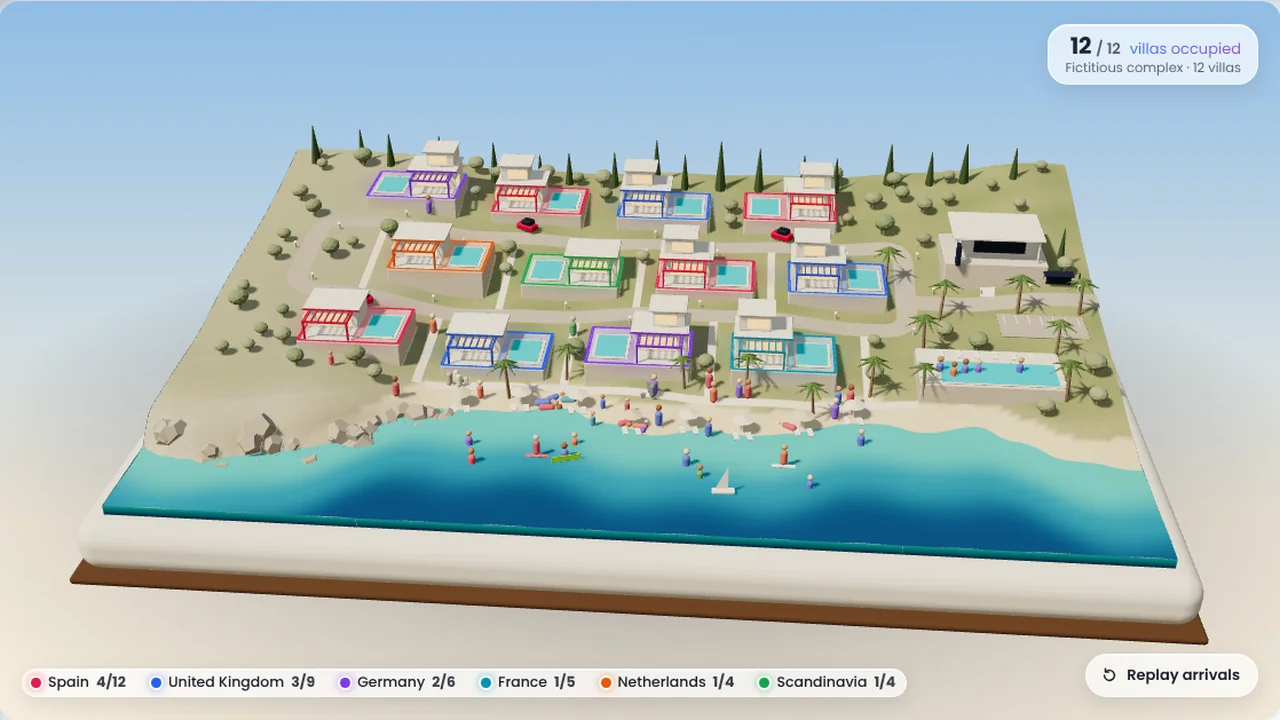
The scene invents nothing: it draws the same numbers you see in the panel. This is how they are worked out:
| Criterion | Calculation |
|---|---|
| Interested households | Those of each date (from 14 in November to 40 in August), split by market according to its weight in the complex |
| Want to book | Households × SubQ’s probability, rounded |
| Villas | If more than 12 want one, villas are shared in proportion and the rest find it full |
| Revenue | Villas × nights of the stay × nightly rate (ADR) |
| RevPAR | Revenue ÷ (12 villas × nights): what each available villa earns |
In 3D each traveller has its country’s colour. Those who book park by their villa, the family gets out and the villa lights up as they go in; late arrivals find it full; those who decide not to come turn back.
The more villas fill up, the more people head to the beach: sunbathers, swimmers, surfers and kids at the shoreline. When it rains, the beach empties.
Cars are markets that arrive by road (Spain, sometimes France) and planes are those that depend on air fares.
Reliability
Verification: SubQ checks the explanation
After the explanation, SubQ comes back to check Mistral with these questions:
Does it make anything up?
Each market’s «why» is checked against its facts and probability: holidays, figures or reasons that are not there count as a failure.
Does it sound certain?
The conclusion cannot present the estimate as a certain forecast or as a real business’s.
If it fails, another round
If any failure probability goes above 70%, Mistral Medium rewrites it and SubQ checks again. If it still fails, it is flagged.
Numbers are off limits
Villas, revenue and the signal are computed by code. Mistral only explains them.
Privacy
Security and data
The same defences as the other agents, reviewed against the OWASP Top 10 for LLM applications.
You type nothing
You only pick closed options. No text of yours reaches a model, so there is no data to leak and no instructions to inject.
Its own keys
IA Ocupación uses its own SubQ and Mistral keys, so its spend and usage are measured separately.
Against abuse
Its own ALTCHA proof of work, per-visitor and global limits, a daily cap on new queries and a one-week cache.
No tracking
The IP is only used in memory for the limits. Usage leaves an anonymous log with the options chosen and the cost.
Honesty
Status and limits
What the agent does today and what it does not, plainly.
What it does today
- It really calls SubQ and Mistral for every new scenario, and shows you the cost.
- It uses the holidays of six markets on five dates, with sources cited.
- It draws in 3D exactly the numbers the code computes.
What it does not do
- The complex is fictitious: the market mix, rates and interested households are assumptions.
- It is not trained on real bookings: it is a scenario estimate, not a forecast.
- It does not look at competitors’ prices or real availability on any channel.
- Weather is a scenario: 90 days ahead nobody can forecast a given day.
For a real business, a CSV of past bookings and the list of units would be enough to start.
Key points
- Facts: From the dates, code gathers each market’s holidays and how it travels, plus the weather, fares, your rate and uncertainty. No AI.
- SubQ decides: For each market it answers a yes/no question: would a typical household book in this scenario? It returns the probability.
- Simulation: Code turns the probabilities into villas, revenue, RevPAR and a signal: demand above capacity, balanced or low occupancy.
- Mistral explains: It explains why each market comes or not, only from those facts and numbers, and suggests what to test.
- You see it in 3D: Travellers from each country arrive at the complex: they book, find it full or turn back. You decide.
FAQ
Frequently asked questions
How do you forecast hotel occupancy?
Start from bookings on the books and the booking pace compared with the same lead time in past seasons, then add what changes demand: holidays at origin, events, weather, prices. Always check the forecast beats last year’s figures.
Does IA Ocupación forecast my property’s occupancy?
No. It simulates a fictitious complex to show the method. With your data, the agent would be trained on your booking history and compared with last year before use.
What does SubQ do and what does Mistral do?
SubQ decides: it gives the probability that each market books and then checks the explanation. Mistral writes the explanation in plain language, only from the facts and the computed numbers.
Why do other countries’ holidays matter?
Because demand starts where the guest lives. Ascension Day, for example, is a holiday in Germany, France, the Netherlands and Scandinavia, but not in Spain.
How does the jet fuel price rise affect it?
It makes air fares dearer. In the scenario it weighs more on markets that can only fly, like the UK or Scandinavia, than on Spain, which arrives by car or train.
How do you deploy AI agents in hospitality management?
Start with one decision and your own data, keep the rules in code, let the model decide or explain only where it adds value, check its output and measure it against a simple baseline before trusting it.
Does it store any of my data?
You type nothing, you only pick options. An anonymous log of the options and the cost of each query is kept, with no IP or personal data.
Custom AI agents
Want an agent like this with your property’s data?
We design it with your booking history, your markets and your rules, and compare it with last year before using it.
Sources of the facts
Spain’s holidays in December 2026, the date of Ascension Day 2027 and how jet fuel and air fares moved in 2026:
This article was created with the help of AI and reviewed by José Galán. I take great care over every post and every translation, but the odd mistake can still slip through. If you find one, write to me: you will be helping me improve.